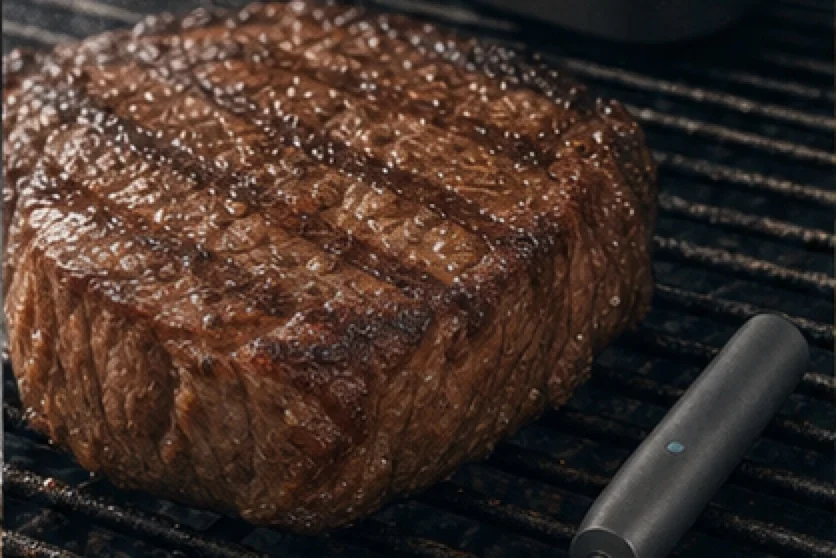
The Combustion Predictive Thermometer Gen 2 is our top single-probe pick. Its eight sensors and cook-time forecast give careful cooks more data than most wireless thermometers. ThermoWorks RFX is the stronger choice for long radio range and several thermometers. Typhur Sync Gold Dual is best when you want a useful base display without reaching for a phone.
Affiliate disclosure: Hats of Meat may earn a commission from certain links. That never changes our research, ranking, or price. Prices and product specifications were checked on July 16, 2026.
Quick comparison
- Combustion Gen 2: Bluetooth; network access with an extra accessory; $149.
- FireBoard Pulse: Bluetooth and S1G radio with a compatible base; $149 per probe.
- FireBoard 2: Home network and Bluetooth 4.0; $199.
- MEATER Pro: Bluetooth 5.2; $99.99 sale, $129.95 list.
- MeatStick 4X: Bluetooth extender; network access with a bridge; $124.99.
- ThermoWorks RFX: Radio to an internet gateway; $265 dual kit.
- Typhur Sync Gold Dual: Sub-1G, home network, and Bluetooth; $199.99 sale, $229.99 list.
These picks come from current thermometer specifications, connection design, thermometer and sensor count, stated temperature limits, price, and common buyer concerns. We did not run unpublished accuracy, range, or battery tests.
How we picked the best wireless thermometers
A good wireless meat thermometer must answer two questions: what is the food temperature, and will the alert reach you? We favored digital thermometers that publish a sensor layout, heat limits, battery information, water-resistance rating, and a clear connection method. Probe count came first for cooks who track more than one steak or roast. Sensor placement also matters. Several internal sensors can help find the coolest part of a thick cut. A sensor near the thermometer handle reads air around the food, but meat can shield it from the true pit temperature. Serious smoker control is often better with a separate grate thermometer.
We also checked whether a thermometer system needs a phone, gateway, booster, or paid extra. A low thermometer price can hide the cost of the receiver needed for long range.
A good meat thermometer should give accurate readings at the target temperature and make a lost connection obvious. We checked retail price, wireless range, temperature range, minimum insertion depth, battery life, probes included, and whether the display feels user friendly. A leave in thermometer tracks a long cook; an instant read thermometer checks several spots before serving. A good meat thermometer also needs a steady temperature reading. Keep an instant read thermometer for spot checks. An instant read check can catch poor placement, while a second instant read check can compare multiple pieces side by side.
1. Combustion Predictive Thermometer Gen 2: best for cook forecasts
Price: $149
Sensors: Eight along one probe
Connection: Bluetooth; Wi-Fi needs a compatible accessory
Best for: Cooks who want a predicted finish time Combustion Inc. places eight internal temperature sensors along a short, thick thermometer. Its software uses those readings to estimate when the food will reach the target. That makes it more than a remote thermometer: it is a timing tool for roasts, steaks, and low-and-slow cooks.
The thermometer is 3.8 inches long and needs about 1.97 inches of insertion. Its upper exposed section has a stated peak limit of 900°F. The maker lists IP69K and IP68 water resistance. Those details suit hot grills and cleanup, though size can be awkward in a thin chop.
The catch is the screen—or lack of one. A phone app is required for a basic one-probe setup. Network monitoring needs a Range Extending Booster or Display that is sold separately. The current Combustion Gen 2 specifications list a 30-day money-back period. Good: Many internal readings, prediction tools, high stated temperature limit.
Watch: App dependence and added cost for network access.
2. FireBoard Pulse: best for a metal smoker
Price: $149 per probe
Sensors: One internal and one ambient
Connection: Bluetooth 5.3; S1G radio with a compatible FireBoard base
Best for: Cooks who already use FireBoard gear FireBoard Pulse uses Bluetooth for a direct connection and low-frequency S1G radio for longer reach through a compatible FireBoard unit and antenna. Lower-frequency radio can be a better match for a thick metal cooker than Bluetooth alone. It also ties into FireBoard cloud charts and multi-probe tools.
The internal sensor covers 14°F to 212°F with stated accuracy of ±0.4°F. The outside stainless section is rated from 32°F to 662°F and may withstand 806°F for up to 3.5 minutes, according to FireBoard. The IP67 thermometer has a stated 24-hour battery life and a ten-minute charge time.
Pulse is expensive if you need the S1G receiver too. A cook starting from zero should price the thermometer, compatible base, antenna, and any extra probes as one system. FireBoard 2 remains a strong wired-thermometer base for cooks who want up to six channels, app and web charts, and optional blower control; it is not a cable-free thermometer on its own. Good: Dual connection paths, fast charging, detailed cloud tools.
Watch: Long-range features depend on other FireBoard hardware.
3. FireBoard 2: best digital meat thermometer for wired systems
Price: $199
Sensors: Six external probe channels
Connection: Home network and Bluetooth 4.0
Best for: Smoker cooks who want app, web, and receiver controls FireBoard 2 is a smart meat thermometer base with a clear LCD screen, cloud charts, and room for six wired probes. The standard kit includes a pair of food sensors and one ambient temperature thermometer. Its food-and-pit setup is not completely wireless, but cables can be a fair trade for stable readings and a grate-level ambient temp.
The listed thermometer range runs from -94°F to 752°F with stated accuracy of ±0.7°F plus 0.1% of the reading. Standard food thermometer cables have their own lower temperature rating, so the thermometer specification—not only the base range—sets the safe limit. A Drive cable or FireBoard 2 Drive model adds fan control for a smoker.
FireBoard 2 is the best Bluetooth meat thermometer in this group for users who also want a home network, a web portal, six channels, and a screen. It is less convenient for rotisserie use or anyone set on a cable-free wireless thermometer. Good: Six channels, network cloud charts, optional blower control.
Watch: Wired probes and a steeper setup than a single-sensor app.
4. MEATER Pro: best simple wireless thermometer
Price: $99.99 sale; $129.95 list
Sensors: Five internal sensors and one ambient sensor
Connection: Bluetooth 5.2
Best for: Weeknight roasts and cooks who want fewer parts MEATER Pro packs five internal sensors and one ambient sensor into a wireless thermometer. The charging case is small, and fast charging makes it easier to recover from a forgotten battery. The company states a maximum internal temperature of 221°F and an ambient limit of 1,000°F.
The listed thermometer range is up to 250 feet, but Bluetooth range changes fast around walls and metal. There is no screen on the thermometer or charging block, so the phone app carries the temperature reading and alerts. The dishwasher-safe claim is handy for a thermometer that will collect grease.
MEATER Pro is less costly than several prediction or gateway kits and asks for little setup. It is a poor fit for four steaks at different doneness levels unless you buy several thermometers or a larger MEATER system. Good: Six sensing points, high ambient temperature claim, small charging case.
Watch: App-only readout and Bluetooth-only reach.
5. MeatStick 4X: best app thermometer with extender choices
Price: $124.99 for the 4X set when checked
Sensors: Three internal sensors and one ambient sensor
Connection: Bluetooth through an extender; network access with a separate bridge
Best for: Long cooks that may need a network upgrade MeatStick 4X combines a four-sensor thermometer with an Xtender built into its charger. The maker claims more than 650 feet of open-space reach through that charger. A Wi-Fi Bridge can carry readings through the cloud when local wireless range is not enough.
The three internal sensors read up to 212°F. The ambient temperature sensor and ceramic handle are rated to 572°F. Stated accuracy is ±1°F, and battery life is listed above 70 hours. The thermometer is sold in several colors, which helps a multi-thermometer cook match each reading to a cut.
This completely wireless thermometer costs less than several gateway kits and can grow with extra hardware. Its 572°F ambient temperature tolerance is lower than the 900°F-plus claims on Combustion, MEATER Pro, RFX, Typhur, CHEF iQ, and ThermoPro. Keep it away from a direct high-temperature sear. Good: Four sensors, long stated battery life, optional network bridge.
Watch: Extender and bridge claims depend on the exact package; 572°F handle limit.
6. ThermoWorks RFX: best long-range multi-thermometer kit
Price: $265 for the current dual starter kit
Sensors: Four internal sensors per wireless thermometer; separate wired ambient thermometer
Connection: Radio to a network and Bluetooth gateway
Best for: Smokers, large yards, and several cuts RFX separates food and pit measurement. Each wireless probe uses four internal sensors. A wired ambient thermometer probe connects to the gateway for grate temperature. That setup is less tidy than a single fully wireless probe, but the grate reading is not crowded by cold meat.
ThermoWorks claims up to 1,500 feet of line-of-sight radio range. The RFX meat probe is rated IP69K, with more than 65 hours of stated battery life on a full charge. Its exposed section can handle up to 1,000°F, while internal measurement tops out at 212°F. Stated accuracy is ±0.9°F.
The two-probe kit price includes a gateway and one wired ambient probe. A four-probe kit was $389 when checked. That is a serious spend, but it is easier to justify for several pork shoulders or briskets than for one weeknight steak. The RFX starter-kit details also show that the gateway carries readings to Wi-Fi. Good: Long stated range, several probes, separate grate measurement.
Watch: Gateway is required; ambient monitoring still uses a wire.
7. Typhur Sync Gold Dual: best receiver display
Price: $199.99 sale; $229.99 list
Sensors: Five internal sensors and one ambient sensor on each of two probes
Connection: Sub-1G radio, Wi-Fi, and Bluetooth
Best for: Two-cut cooks who want phone-free checks Typhur gives each of its two probes six sensing points and pairs them with a 2.4-inch color base. That screen shows temperatures and controls without a phone. Wi-Fi and Bluetooth add app access, while sub-1G radio links the probes to the base.
The maker lists ±0.5°F accuracy, an ambient heat limit of 932°F, and IPX8 probe protection. Its range claims are up to 3,000 feet in open space and 700 feet with obstructions. Real homes and grills will vary, but the lower-frequency link is well suited to crossing more than a clear patio.
The base and app include prediction and presets. That amount of software may feel busy for a cook who wants one temperature and one alarm. For two steaks, a roast plus a smoker, or a turkey with two monitored spots, the hardware makes more sense. Good: A paired system, clear base display, three connection methods.
Watch: Many controls and a high dual-kit price.
How to choose a wireless grill thermometer
Start with probe count and sensor placement. Serious grillers may choose a single probe version for one roast, or a hub with up to four probes for smoking meats, pork butt, pork loin, and chicken breasts. Multiple sensors in one thermometer do not replace separate devices for different cuts.
Insert the probe past its marked minimum and aim for the thickest part, away from bone and large seams of fat. For thin food, a short minimum insertion length matters more than an eight-sensor claim.
Match the wireless method to your home. A Bluetooth thermometer is fine when the grill and smart phone stay close. A home network can carry alerts anywhere with internet access, but it needs a stable router and often a hub. Sub-1G or other radio frequency links tend to travel farther and pass through cooker walls better, then hand data to a receiver or gateway.
No range number is universal. Other factors include brick, metal, distance, nearby signals, and where the receiver sits.
Check two temperature limits. A wireless thermometer has an internal food limit and an exposed ambient limit. The upper shaft may survive a fast sear while the buried tip must stay far cooler. Read both numbers. Never leave the device over direct flame unless the maker allows it.
Pick a screen or an app. An app can draw graphs and send remote alerts. A receiver display is faster when hands are greasy, a phone is charging, or the network is down. Typhur provides the strongest base display in this group. RFX and CHEF iQ also reduce phone dependence through their gateways.
Count the full system price. A $149 thermometer that needs a base can cost more than a $200 dual kit. Add the gateway, other probes, charger, and any paid cloud features before comparing value. Check the food sensor warranty as well as the warranty on the base.
Wireless range, ambient readings, testing, and care
Line-of-sight range describes open space, not a home. A steel smoker, oven, brick wall, or low receiver can cause a shorter range or lost connection. Bluetooth sends readings to a nearby phone or base. A booster repeats that signal. Home-network systems support remote alerts, while radio frequency links often travel through cooker walls better. Test the connection at the farthest room before smoking meats overnight.
Bluetooth capabilities differ by system. Some digital thermometers use both Bluetooth and a network gateway; others rely on Bluetooth connectivity alone. Place the gateway in a dry spot near the grill, never on a hot lid. Outdoor cooking with multiple pieces of meat may justify multiple probes, while a single steak does not.
Internal temperature and ambient temperature answer different questions. Aim the food sensor at the thickest part and insert it past the minimum insertion depth. A handle-mounted ambient sensor may read low beside cold meat. For pit control, place an ambient probe near the grate and away from a wall, water pan, or flame.
Thermometer testing at home can flag a damaged thermometer. An ice bath should settle near 32°F at sea level. Boiling water changes with elevation. If many digital thermometers show an inaccurate reading in the same well-mixed bath, check placement, seals, and allowed offsets before reading temperatures during a cook. No simple test turns a maker claim into lab proof.
Set a food alarm near the target temperature and high-and-low pit alerts for a long cook. Allow notifications so the phone does not silence the temperature reading. A base with its own speaker gives a useful second warning.
Water ratings describe different tests. Follow the maker’s cleaning rules, even when deep frying or dishwasher use is allowed. Let the thermometer cool, clean each thermometer probe and its charging contacts, then dry them before storage. Wide loops protect wired leads. Charge every thermometer before a long smoke and handle firmware updates before the grill is hot.
Safe temperatures still need judgment
A smart thermometer does not choose a safe target for you. The USDA beef safety guidance calls for whole beef steaks and roasts to reach 145°F with a three-minute rest. Ground beef should reach 160°F. Poultry should reach 165°F.
Some apps offer lower chef-style presets for steak. Treat a preset as a preference, not a food-safety rule. Also verify doneness with a second instant read thermometer if a reading seems wrong or the probe was not inserted far enough.
Our verdict
For a perfect steak, Combustion Gen 2 is the strongest pick for prediction and dense temperature data. ThermoWorks RFX suits several probes, a separate grate reading, and long radio range. Typhur Sync Gold Dual is the strongest two-probe system with a useful screen.
MEATER Pro keeps the setup small. CHEF iQ and ThermoPro bring Wi-Fi at a lower entry price. FireBoard Pulse makes the most sense for someone already invested in a FireBoard base.
Pair the right probe with a cut worth watching. Our meat subscription comparison covers freezer-ready options, while the Good Ranchers research review checks one seller’s plans and policies.
Frequently asked questions
Is Wi-Fi better than Bluetooth for a meat thermometer?
Wi-Fi gives remote access beyond the yard, but it needs a network and often a gateway. Bluetooth is quicker for a phone nearby. Radio systems such as RFX or sub-1G links can be better between a metal smoker and a base station.
Can a wireless probe stay in during searing?
Only if both parts of the probe are rated for the heat. The internal tip and exposed handle have different limits. Keep the insertion line inside the food and follow the maker’s time limit for very high heat.
Why does the ambient sensor read low?
Cold meat can block heat from a sensor sitting close to its surface. A separate grate probe, placed a few inches from the food, often gives a better pit reading.
How many probes do I need?
Use one per cut when size or target doneness differs. One is enough for a single roast. Two cover a pair of steaks or meat plus a backup spot. Four or more suit a crowded smoker.
About the research
Hats of Meat compared product pages, support files, sensor layouts, wireless methods, water ratings, kit contents, and prices on July 16, 2026. We did not run first-hand range or accuracy tests; maker figures remain labeled claims.